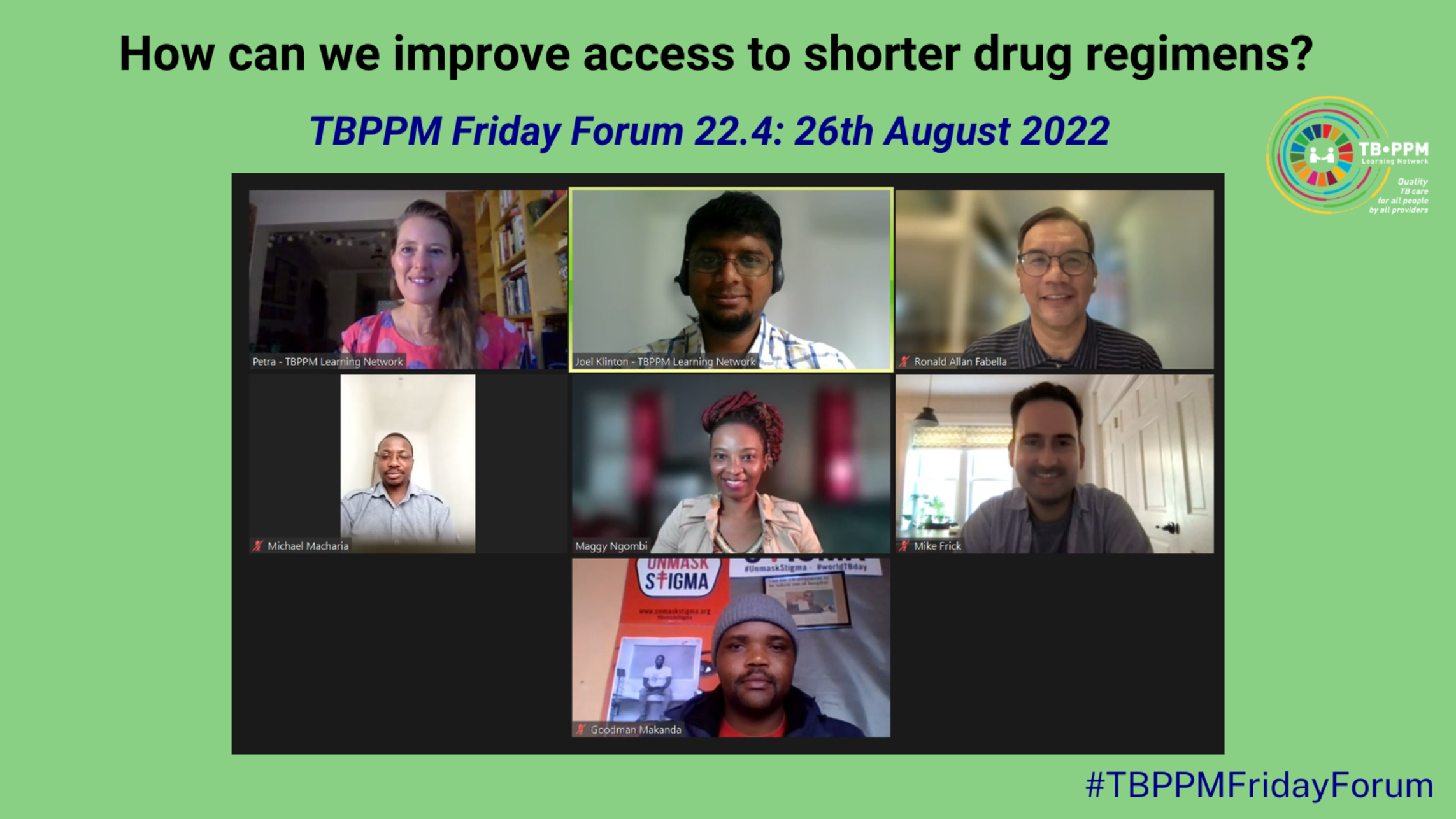
TBPPM Friday Forum: How can we improve access to shorter drug regimens?
On the TBPPM Friday Forum held on August 26th, 2022, a panel of implementers, public health specialists, TB survivors and researchers discussed the challenges and opportunities for access to newly available shorter Tuberculosis drug regimen and why everyone needs to be an active advocate for better access to these. This is the focus of the 1/ 4/ 6/ x 24 Campaign (Initiated by TAG, PIH and MSF).
The Pipeline report published by Treatment Action Group in 2021 has outlined the forward momentum observed in TB treatment, vaccines, and preventive treatment in the last 20 years. Advances in science have made it possible to treat TB infection in as little as one month, and most forms of drug-sensitive and drug-resistant TB in four to six months, respectively. Despite these advances and breakthroughs in TB research, significant effort is still needed to implement and scale up these shorter drug regimens.
The uptake of these shorter regimens faces several barriers such as lack of awareness, poor access to TB care, limited capacity to diagnose and treat TB, and the lack of availability of the newer drugs that constitute some of these short regimens. Efforts to scale up these innovations have also been undermined.
The panelists in the Friday Forum shared key information from their experiences which is summarized below.
1. What are the benefits of shorter regimens for Tuberculosis? How do we start as communities advocating for this?
Benefit for people with TB
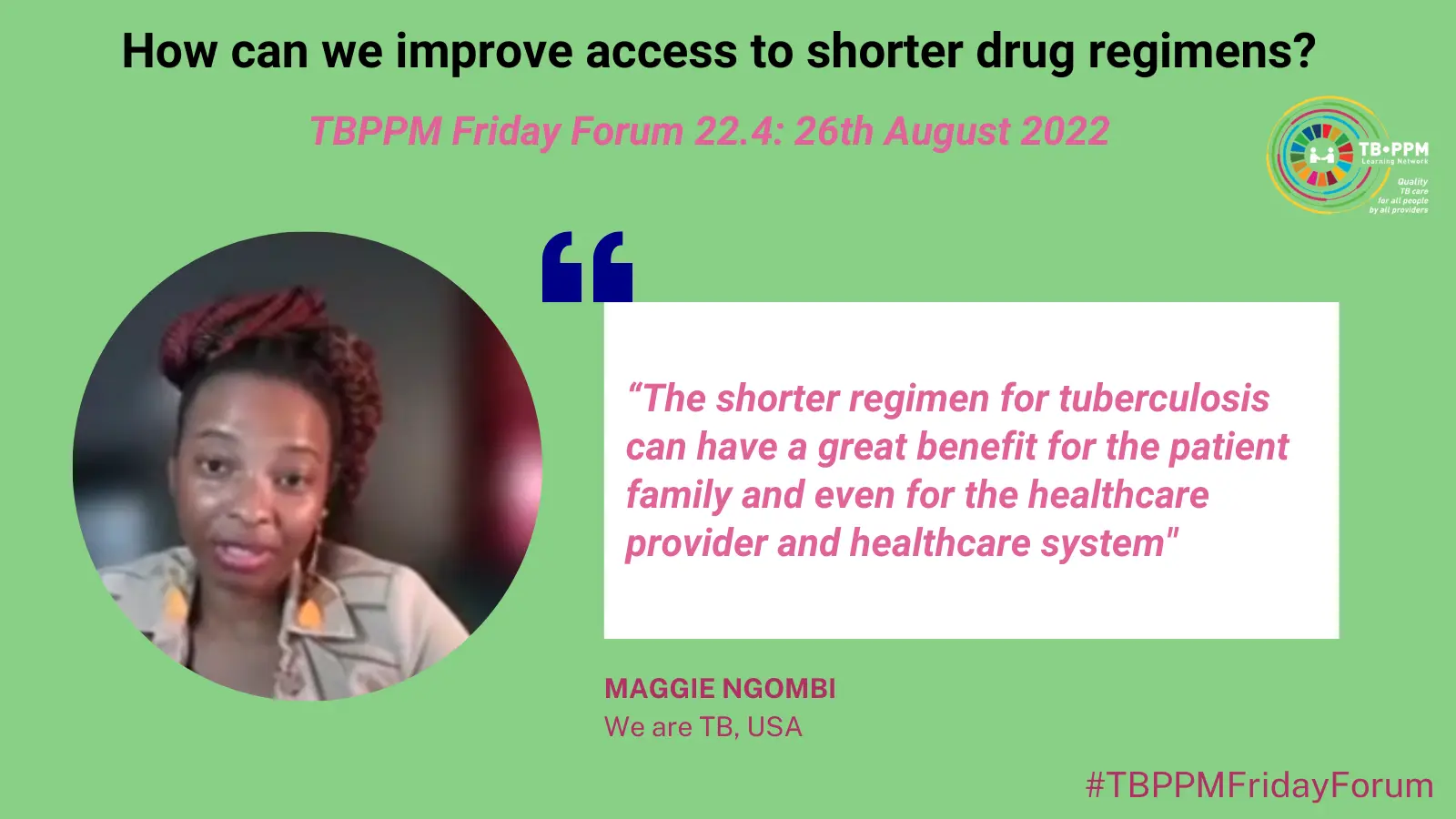
“The shorter regimen for tuberculosis can have a great benefit for the people with TB and their family and even for the healthcare provider and healthcare system. The regimen that you want can help people more easily to complete the treatment for TB compared to the one I was on because not only is 4 months period short compared to 2-year period and enables the patient to be cured faster but also have the potential to reduce the treatment cost.” ~ Maggie Ngombi
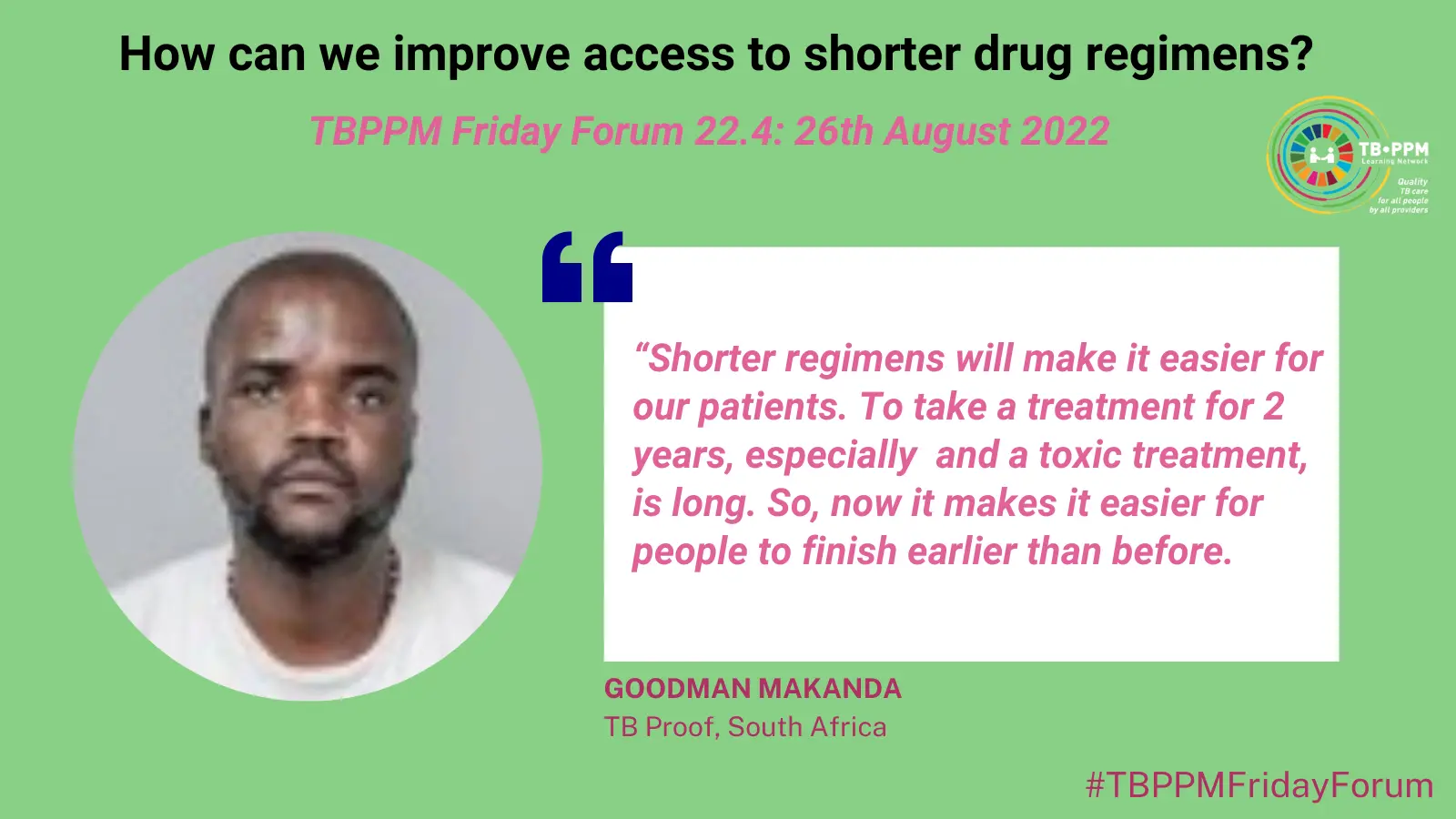
“Shorter regimens will make it easier for our patients. To take treatment for 2 years, especially a toxic treatment is long. So now it makes it easier for them to finish earlier than before. Normally we have a loss to follow up because people get tired of taking medication every day for 24 months.” ~ Goodman Makanda
“It’s also about tolerability, side effects, the pills people are expected to take and the treatment literacy of patients. We need to be sharing information and educating the public. You want people who are diagnosed with TB to go to the clinic and say, “I’ve heard about this 4-month regiment, am I eligible for that?” ~ Mike Frick
“It’s a no-brainer campaign. There isn’t a single person alive who’ll happily say that I’ll take a 24-month regimen if I can take a 6-month one instead.” ~ Madhukar Pai
“There are a lot of challenges when you are taking the treatment. All those challenges are making our patients run away from the treatment. We need support. We need TB survivors to counsel patients, and explain to them where we come from. So that they can understand that we’re coming from injections and from 24 tablets a day, but now we have 6 tablets a day. This can benefit our patient to finish treatment early.” ~ Goodman Makanda
Government Benefit
“It is cost-effective for the government. Shorter the period of treatment, the government can save more money.” ~ Maggie Ngombi
“When governments start to procure drugs for the new regimen, the registration of the new drugs would always be local.” ~ Ronald Allan Fabella
Awareness of the shorter regimen
“The problem is when people reach the healthcare facility, they don’t know they have the right to get a shorter regimen, instead of a long regimen. Through all this, our community is going to benefit, because it is our right. The government has a responsibility to provide this medication. There is no community without government and no government without community.” ~ Goodman Makanda
“Whenever we have a transition to a new regiment, one of the concerns for programs is the current stocks, of old regiment drugs. Under the program, we usually procure from 6 months to 1 year worth of supply. And so, it happens when we have new drugs and new regimens, it’s a big concern. What do we do with the drugs that are part of the old longer regimen?” ~ Ronald Allan Fabella
“TB patients that contact me through social media are unaware of what is going on with them, education is missing, and they are not aware of medicines. The reason I wanted to attend this webinar is that I wasn’t sure about the presence of this four-month regimen either. In the same way, people who are afflicted with TB, aren’t aware of it. There needs to be someone who can tell them that these are available, it's not like it's something which we as a patient know that this is available.” ~ Keyuri Bhanushali
"This is a good time to start a discussion on this, will there be flexibility from the suppliers including GDF as our main supplier of second-line drugs? Will there be flexibility if we have already placed orders for the old regimen?” ~ Ronald Allan Fabella
2. A panelist, Phumeza Tisile, asked, “are there countries that still give out the injectables? If yes, why?”
Killing Injectables
“We do have an active civil society and patient group movement that is actively participating in the program, so they are involved in the decision making. When they advocate and demand it, that’s one motivation/pressure for the government to drop injectables”. ~ Ronald Allan Fabella
“When we first moved to all oral treatment for drug-resistant TB, some countries were still trying to fully transition with a lot of injectables lying around. These injectables need to be stopped because they are very toxic and painful.” ~ Mike Frick
“Most of our injectables are GlobalFund procured, so there is the discussion with GlobalFund. If it were government-procured injectables, there would be more resistance or more reservation to just dispose of it because government funding and budget tend to be more rigid in terms of auditing. In the end, the patient interest must come as primary over all these other concerns” ~ Ronald Allan Fabella
Government obligations: a patient-centered approach
“Another element from a country perspective is looking at the cost of procurement. For Kenya for example, the procurement is done mainly through donor funding, mainly through Global Fund and we have also support coming from foreign foundations like CHAI. For our country, it doesn’t matter what type of TB a patient has, be it drug-sensitive or drug-resistant TB, extremely drug-resistant TB, all forms of TB it is free treatment. All a patient comes in to get medication and even the investigation, the bulk of it is footed by the government.” ~ Michael Macharia
“I think meeting patients where they are is important in the treatment of patients. The more I think about patient-centered care, that piece can’t be lost. Yes, there are shorter regimens but are we meeting patients where they are to ensure that they want to even embrace this regimen.” ~ Tina Shah
Training healthcare workers
“You have to consider the panel of experts you have in the country. These panel of experts has to be convinced without a doubt that whatever is being introduced, like the shorter regimen, they will work” ~ Michael Macharia
“TB disease and especially some long-term disease, the process of healing is not only physical ….in the US some healthcare workers aren’t really trained to take care of the health of their patient. It takes medicine to heal your body, it takes a lot of care, a lot of commitment, and a deep commitment to healing someone, to enable someone to understand what’s going around them. Enable someone to understand the depression you’re going through right now; it’s going to pass.” ~ Maggie Ngombi
“TB is kind of a stigmatized disease, to train people/healthcare worker/anybody that is going to have a one on one with the patient, to understand that they will have depression and must understand how to handle depression. How to handle mental health. This is one of the things, the civil society and the government should align and make sure that it is a priority, and we see that in COVID-19.” ~ Maggie Ngombi
“TB healing is more than just physical.” ~ Mike Frick
“It's not all about the medication, it's also about the support system such as counseling. When we are doing this campaign for a shorter regimen, we should be also addressing the stigma to the community so that they know TB is a normal disease like any other.” ~ Goodman Makanda
Post TB treatment surveillance
“We must think about the element of post TB treatment surveillance. There are some patients who have post-TB treatment complications, post-TB disease complications. This is an element that we have not really invested in and will require to invest substantially.” ~ Michael Macharia
“We need to invest in post TB treatment surveillance, post TB disease surveillance, for purposes of equipping our health care workers to look as post TB disease complications. This way, we can look at improving the quality of life of those who have been affected by TB directly, also take care of the needs of those who take care of them.” ~ Michael Macharia
“We know from history, that the TB field is very refractive even to no-brainer issues. What you and I thought was absolutely a no-brainer, we are still waiting for it to happen in the TB field. We should never assume that things will just happen, we must make that happen.” ~ Madhukar Pai
Patient care
“I would love to see countries that have the capabilities to phase out in DOT for patients that really don’t need it. Now with the pandemic, we’ve been able to able to do a lot of electronic stuff, I would like to see e-DOT or video-DOT become the norm. The majority of patients will be fine.” ~ Tina Shah
“We have a long history of very strict directly observed treatment (DOT) and this is a barrier for some patients to receive the treatment. It's not just the new commodities, the new drugs the new technology, but also how we provide care. Patient-centered care is now included in most of the NTP policies. This new way of treatment adherence like providing more education and counseling and even digital adherence tools is more beneficial and provides better results.” ~ Ronald Allan Fabella
Advocating for a shorter regimen
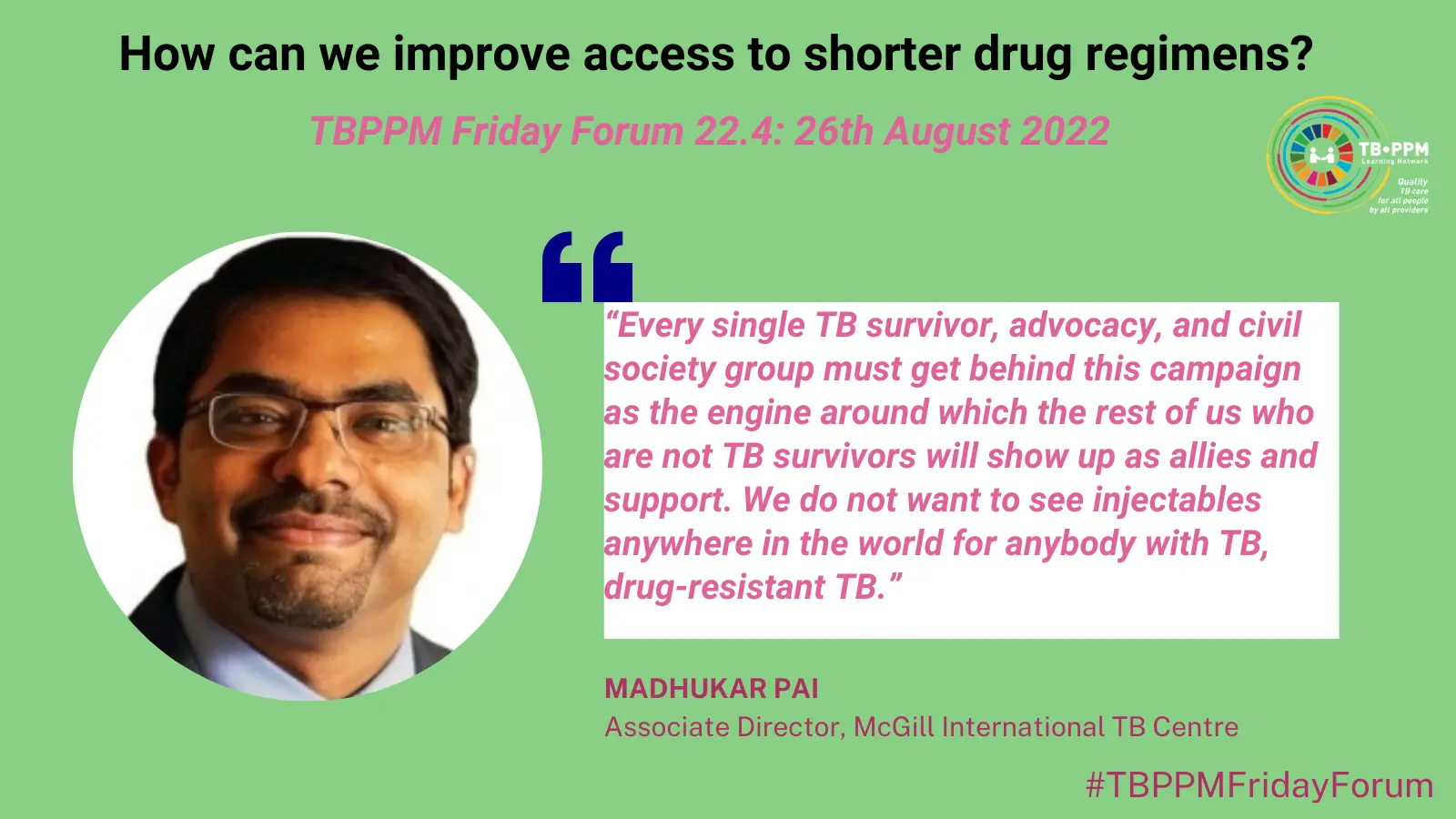
“Every single TB survivor, advocacy, and civil society group must get behind this campaign as the engine around which the rest of us who are not TB survivors will show up as allies and support. We do not want to see injectables anywhere in the world for anybody with TB, drug-resistant TB.” ~ Madhukar Pai
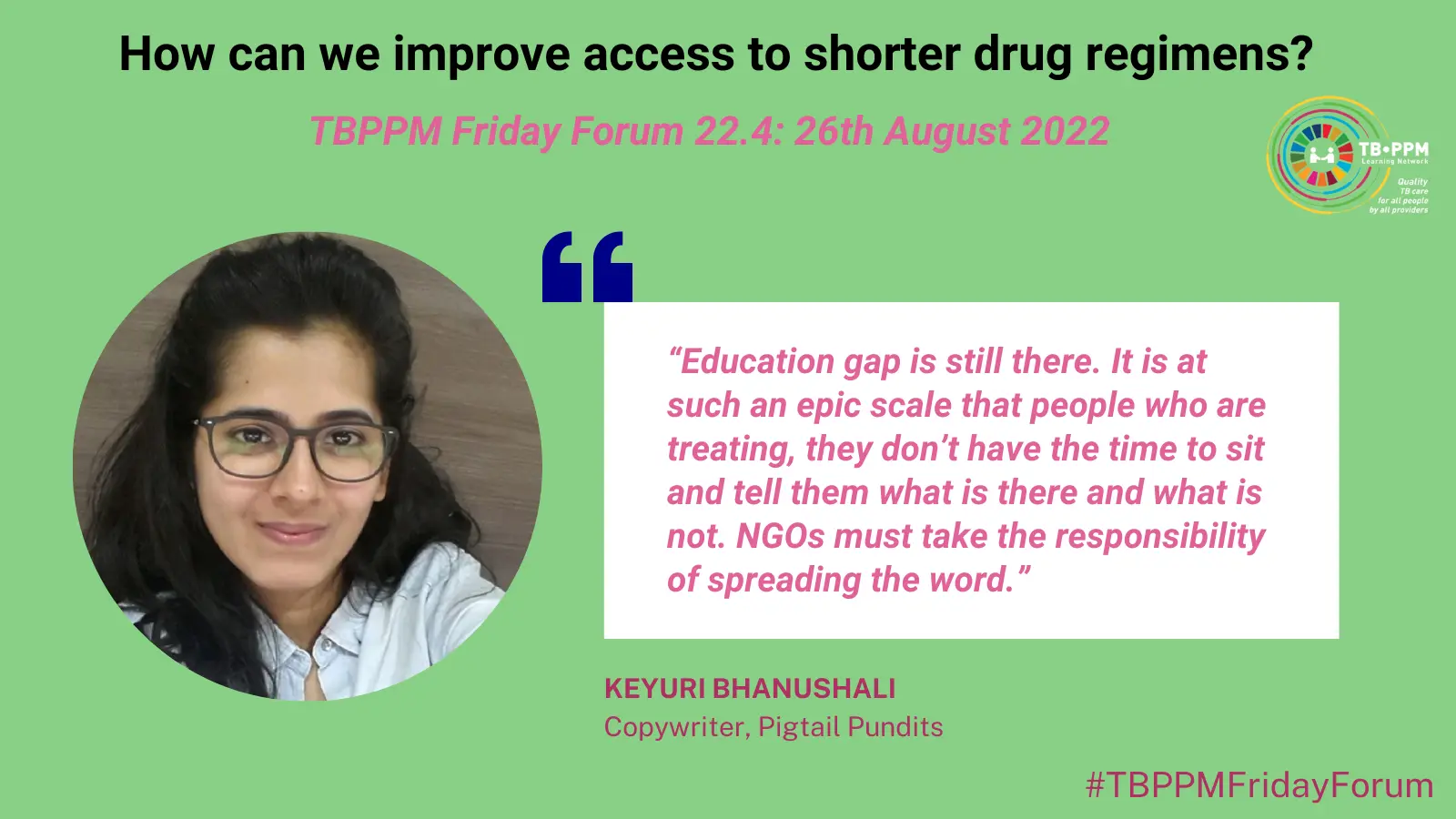
“Education gap is still there. It is at such an epic scale that people who are treating, don’t have the time to sit and tell them what is there and what is not. NGOs must take the responsibility of spreading the word.” ~ Keyuri Bhanushali
“Advocacy is critical for acceptance. For our country right now, we are doing healthcare worker-driven “3HP” campaigns, where the healthcare workers are the first ones in the forefront taking it so that they understand what the patient goes through, and with that, they will be able to craft good messages that would benefit the patient in convincing them to take up this prevention of TB disease in the future.” ~ Michael Macharia
“From a country perspective, one of the things we have done for the advocacy element was to engage communities that have been affected by TB, as well as persons who are currently on treatment for TB, while also looking for TB champions in the same communities. The healthcare worker is at the forefront of advocating for TB prevention.” ~ Michael Macharia
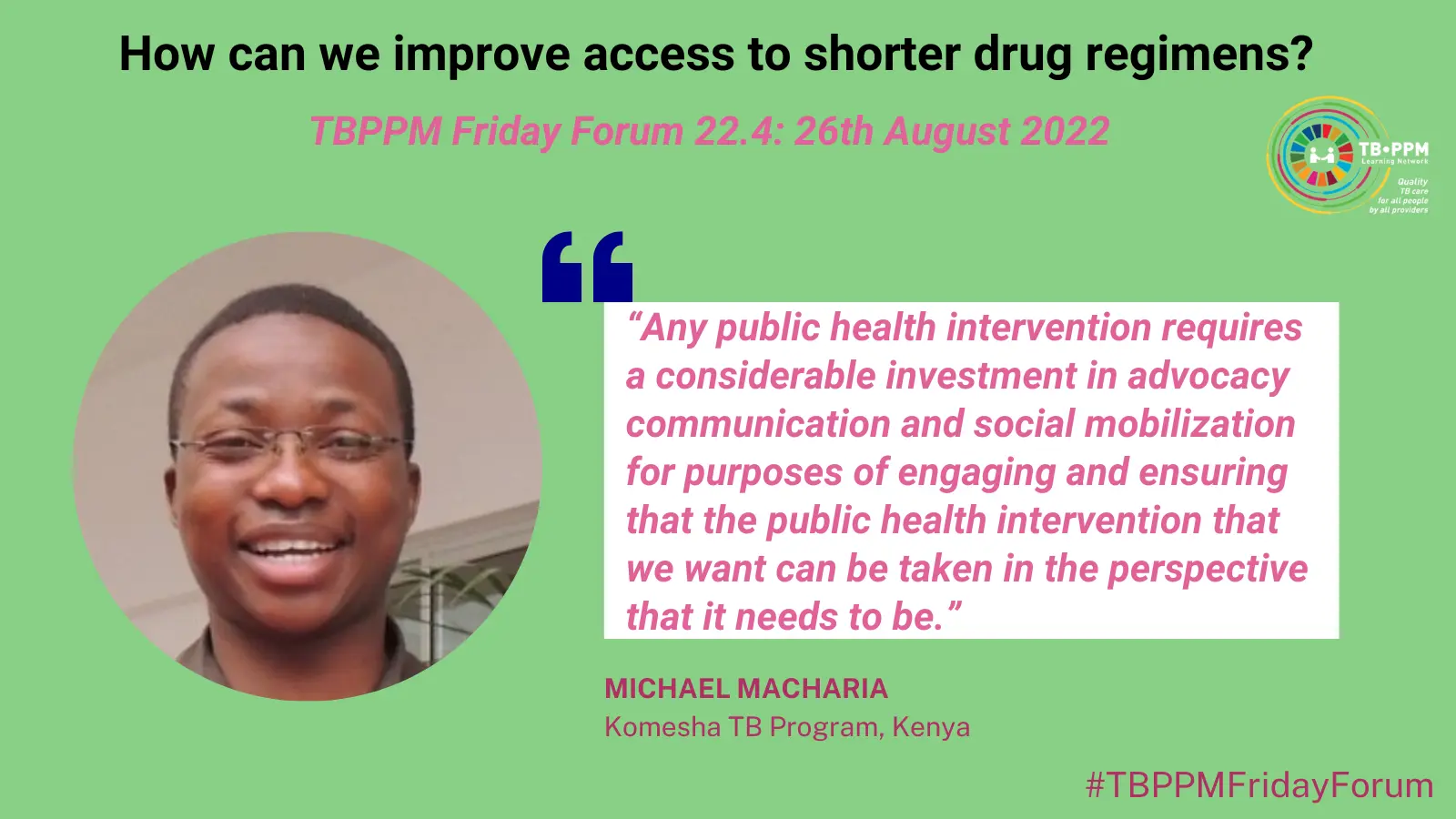
“Any public health intervention requires a considerable investment in advocacy communication and social mobilization for purposes of engaging and ensuring that the public health intervention that we want can be taken in the perspective that it needs to be.” ~ Michael Macharia
Audience member, Vanessa Gutierrez, stated, “It is important to think about patients from indigenous communities because in addition to all the implications of having TB, we must add the little understanding of the worldview of indigenous peoples and sometimes we try to impose without listening or understanding the patient and their vision. of the illness.”
In conclusion, Mike Frick summarized the key points from the discussions and highlighted that the program management side, especially the engagement of all healthcare providers, including private providers, needs to be picked up in further discussions. The Learning Network will provide a future platform for this purpose, and a webinar on Post TB lung disease is being planned to take some of the above issues forward.