
World AIDS Day 2024: Take the rights Path: My health, my right!
World AIDS Day 2024: Take the rights path: My health, my right!
We have made tremendous progress in our fight against AIDS, but the battle is far from over. While today’s world may seem safer from the threat of HIV/AIDS, the reality on the ground remains sobering. Currently, an estimated 39.9 million people are living with HIV globally and in 2023 alone, approximately 630,000 people lost their lives from HIV-related causes. That same year, around 1.3 million new cases of HIV emerged. We might wonder, given the advancement in healthcare and the availability of effective pharmacotherapy to successfully treat AIDS, why we have not been able to end this battle. The reality is that an estimated 9.3 million people living with HIV do not have access to those lifesaving drugs. Therefore, this year's commemoration of World AIDS Day focuses on ensuring human rights and health equity, because inequitable access to healthcare services is hindering the world from ending AIDS. On 1 December WHO collaborates with partners and communities to ensure everyone’s rights are protected. By centering on human rights and empowering the communities to take the lead, we can end AIDS as a public health threat by 2030.
Whenever we consider HIV-related deaths and disabilities, tuberculosis (TB) consistently ranks among the top contributors. HIV and TB form a fatal combination, with each disease accelerating the progress of the other. People living with HIV are 16 times more likely to fall ill with TB disease than people without HIV and in 2023 about 161,000 people died of HIV-associated TB, accounting for nearly 1 in every 4 HIV-related deaths. This highlights the need to integrate both diseases into health programs, as tackling one without addressing the other leaves a critical gap in the fight against ending both.
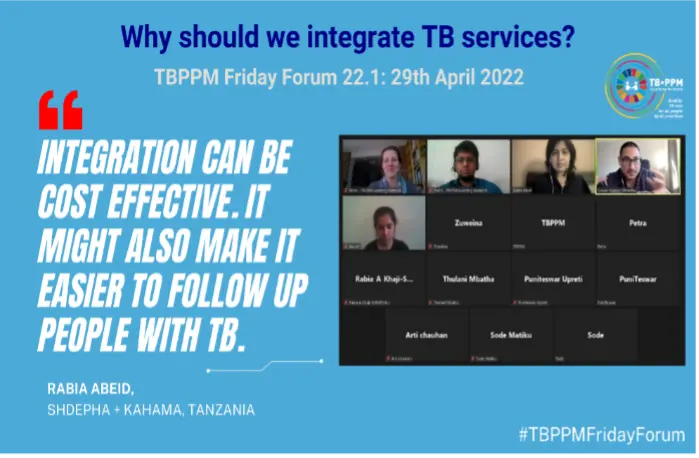
In TBPPM Friday Forum on Integrated TB service delivery (see recording), the experts summarised that health systems are aiming to achieve more people-centered care, and integrating TB services with HIV health programs can prove beneficial to find the missing millions. These integration efforts can improve TB/HIV case detection and/or treatment outcomes while maximizing resources and providing health services to users that can be convenient, safe, and with quality care.
Resources on TBPPM platform:
TB services are commonly integrated with HIV either in the form of screening (TBPPM Webinar 21.6), TB preventive therapy (TBPPM Webinar 21.7) or in services for particular population groups (eg. TBPPM Features: Tackling TB and HIV in mining areas of Tanzania)
Join the online discussions:
This week Friday 29 Nov – 5 Dec 2024, we are discussing “Do you know how the HIV program engages private providers?” – We would love to hear from your experiences and learn more!
 You can also leave comments on an earlier online forum: How can we improve TB services in the private sector for people with HIV?