
Global Tuberculosis Report 2024
TB is now the world’s leading infectious disease, with an estimated 10.8 million people falling ill in 2023. TB notifications reached a record 8.2 million! Thanks to key contributions from the private sector and WHO’s new dashboards, there now is improved TB tracking in 7 countries. But a funding gap remains—only US$ 5.7 billion of the needed US$ 22 billion has been secured.
Curious how we can further close the gaps? Check out the full report!
TB biggest infectious disease, and closing the Gap on missing people
Key points relevant to PPM from the Global TB Report 2024
TB returns as the top infectious disease killer in the newly published 2024 WHO Global Tuberculosis Report (fact-sheet/ full report), now officially replacing Covid 19 in the ranks.
Global rise slowing down, starting to stabilize
Globally in 2023, an estimated 10.8 million people fell ill with TB (incident cases), a further increase from 10.7 million in 2022, 10.4 million in 2021 and 10.1 million in 2020 (Fig. 1). The rate of increase has slowed considerably (to 0.2% between 2022 and 2023) and appears to be levelling off. Eight countries accounted for more than two thirds of the global total: India, Indonesia, China, the Philippines, Pakistan, Nigeria, Bangladesh and the Democratic Republic of the Congo. The top five countries accounted for 56% of the global total. Most of these countries have a large private healthcare sector.
The Good News: Closing the gap of TB notifications
Globally in 2023, 8.2 million people were newly diagnosed with TB and officially notified as a TB case. This is the highest number for a single year since WHO started to compile data from all countries and areas in the mid-1990s, up from the previous record of 7.5 million in 2022 and 15% higher than the pre-pandemic level of 7.1 million in 2019.
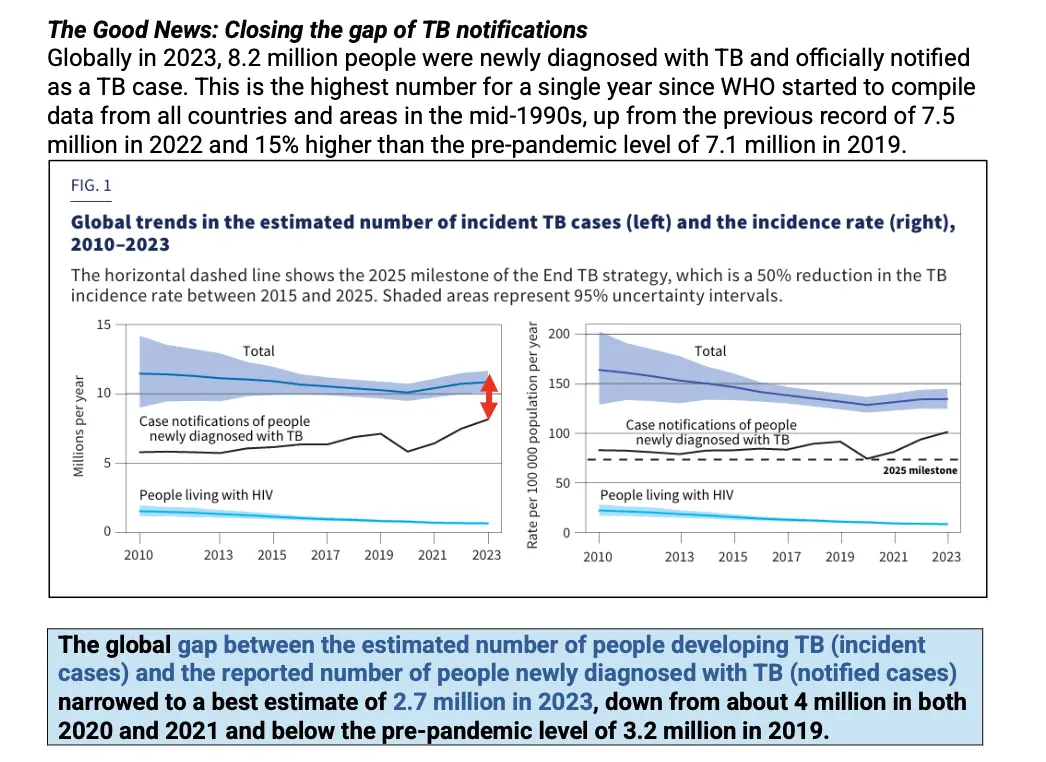
The 2 years of record levels of TB case notifications follow 2 years of serious COVID- related disruptions to TB-related health services, when the reported numbers of people newly diagnosed with TB fell considerably below pre-pandemic levels, most noticeably in 2020 (with a global reduction of 18%, to 5.8 million) before a partial recovery in 2021 (to 6.4 million). The historically high numbers in 2022 and 2023 show that there has been a strong global recovery in the provision of and access to TB diagnosis and treatment. The WHO Report mentions that it is likely that they also reflect two other factors: the diagnosis of a backlog of people who developed TB in previous years but whose diagnosis was delayed by COVID-related disruptions, and an estimated increase in the overall number of people developing TB disease (Figure 1).
Private sector contribution to TB notifications
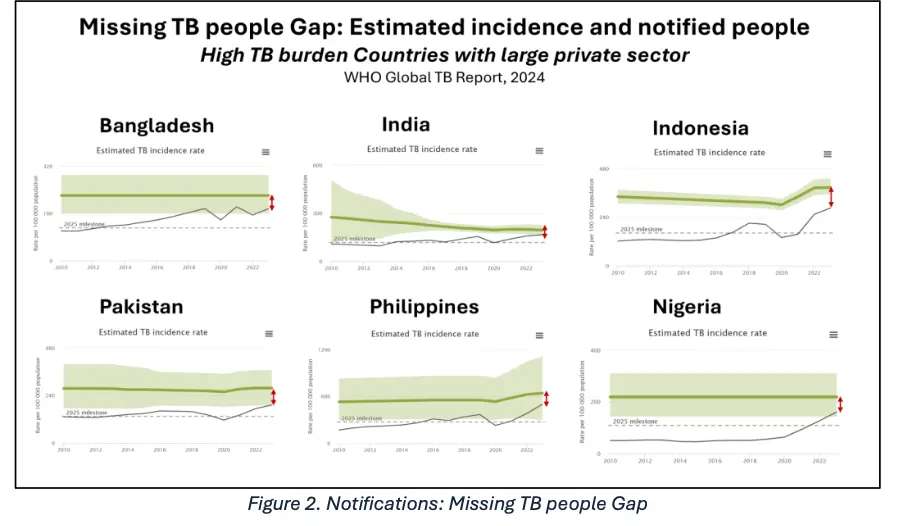
All high TB burden countries with a large private sector (India, Indonesia, Bangladesh, Philippines, Nigeria, Pakistan) are specifically mentioned to contribute - the latter three made major contributions to the global increase between 2021 and 2023: 15%, 9.3% and 7.8% of the global increase, respectively (see figure 2).
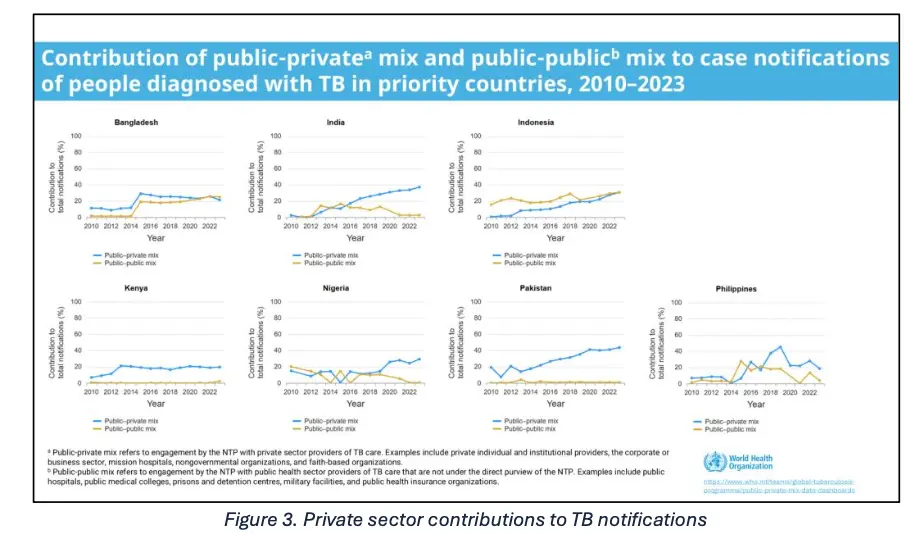
Private and informal providers are often the first point of care for TB patients. The national programs in each of these countries have taken considerable efforts to engage private providers (see WHO PPM Dashboards - Figure 3). The Global Fund invests in TB programs in Bangladesh, Indonesia, Pakistan, Philippines and Nigeria with large private sector engagement projects included under GC7 showing results in notifications from the private providers. In addition, it has funded a strategic initiative on the ‘missing TB millions’.
Countries have mainly focused on tracking notifications from private and unengaged public sector care providers rather than a broader scope of indicators across the patient pathway. Failure to engage with these providers can have negative consequences, including increased transmission, increased drug resistance, catastrophic costs for TB patients and their households, and incomplete monitoring and evaluation. Such consequences can arise from factors such as delayed diagnosis, inappropriate or incomplete treatment and out-of-pocket expenditures.
Public–private mix monitoring and data dashboards in priority countries for stronger accountability

The PPM dashboard show enhanced PPM data in seven priority countries: Bangladesh, India, Indonesia, Kenya, Nigeria, Pakistan and the Philippines. The indicators in the PPM dashboard are aligned with WHO guidance on TB surveillance and with WHO benchmarks and indicators related to universal access to rapid TB diagnostic tests, grouped into four categories: provider coverage, surveillance, service coverage and treatment outcomes.
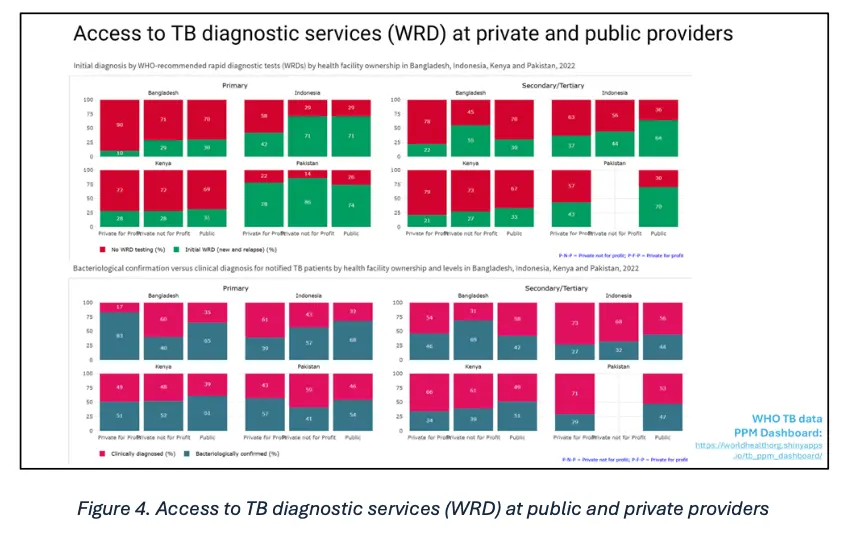
Disaggregation of data by ownership and health facility level are both core components of the PPM dashboard, to better understand patient pathways. Such disaggregation will also provide information about differences among providers in access to services such as WHO-recommended rapid diagnostics (WRD) – see Figure 4.
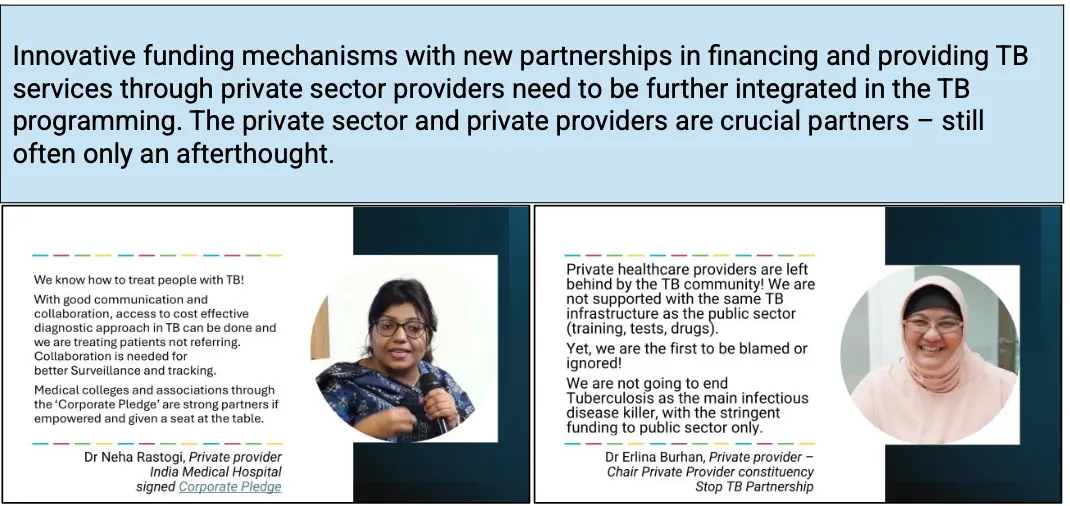
Funding Gap: Innovation required integrating private providers
Ending TB requires that commitments made at the 2023 UN high-level meeting on TB are translated into action, and we are far from reaching the Targets set in implementation of TB services and in funding. The funding for TB prevention, diagnostic and treatment services with a target of US$ 22 billion (status in 2023: US$ 5.7 billion) and funding for TB research has a target of US$ 5 billion (status in 2022, US$ 1.0 billion).