TBPPM Virtual Town Hall 2025
The TBPM Learning Network's 2025 Town Hall meeting celebrated the organization's six-year history and achievements, while exploring future initiatives and announcing sustainability plans. The conversation ended with discussions about the network's future evolution, including new partnerships for continued learning, action, and evidence synthesis in private sector engagement and tuberculosis service delivery.
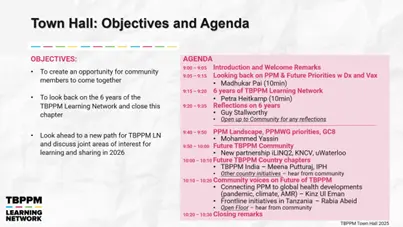
Petra welcomed attendees to the TBPM Learning Network's 2025 Town Hall, noting it would be the last in the current constellation. She outlined the agenda and the aim to reflect on the year's achievements and the network's six-year history, while also exploring future initiatives and sustainability plans for the TBPM Learning Network.
TB Innovation and South-South Partnerships – Introduction by Dr Pai
Madhukar acknowledged Petra's significant contributions over six years in building and maintaining the community, despite challenges like COVID and current global health funding cuts. He highlighted the need for Global South countries to invest more in TB and integrate it into primary care, emphasizing the importance of affordable innovations from the Global South. Madhukar expressed optimism about South-South partnerships and encouraged everyone to continue supporting the TB agenda in these challenging times.
TBPPM Learning Network: 6 years – presentation Petra Heitkamp
The TBPM Learning Network, established in 2019, has grown to include over 6,000 individuals and organizations focused on tuberculosis and private provider engagement. Over the past six years, the network has developed a south-to-south learning framework, emphasizing frontline providers and informal networks, with significant participation from low- and middle-income countries. Despite funding challenges in 2025, the network has maintained its focus on inclusive and implementer-led content. Over the past six years a shift has been seen towards more representation from the Global South and increased female participation in speakers and leadership roles within the TB community at large.
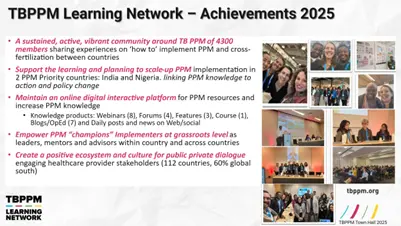
Reflections on TBPPM LN achievements and way forward – by Guy Stallworthy
Guy expressed satisfaction with the Gates Foundation's support for the project, highlighting its success in fostering south-to-south exchange among implementers. He emphasized the importance of practical, lived experience in implementing public health programs, noting that the project has successfully produced over 100 PPM leaders from the Global South. While acknowledging challenges such as integration with UHC/PHC and the need for multiplex technologies, Guy viewed these as opportunities for growth. He encouraged in-person cross-visits and expressed hope that Global South implementers could continue this dynamic work independently, despite the reduction in development assistance. The transition to domestic funding for PPM (Private-Public Mix) work in tuberculosis control is key, with Guy highlighting India as an exemplar of this shift.
“As an organization implementing TB PPM for 20 years, it used to be lonely to share experiences. The TBPPM Learning Network gave us that community — a place to connect, share experiences, and learn from others. Implementation was happening in isolation across the world, and TBPPM connected us. That is a big outcome. You gave us a community to connect to; we feel part of the whole private sector movement and we do not feel alone. It’s been a fantastic experience. We need to keep that community alive — the private sector is going to be there forever, next to the public sector. This applies beyond TB. A PPM learning network can exist for any condition affecting communities. It’s about a sense of belonging and a sense of community.”
— Ramya Ananthakrishnan, TBPPM Learning Network Town Hall
The Global Fund TB: GC8 and private sector engagement
Mohammed reflected on the TB response journey over the past six years, highlighting the network's contributions and the need for self-reliance and sustainability. He emphasized the importance of private sector engagement, even in low-funding scenarios, and discussed the challenges of global funding cuts. Mohammed explained that Global Fund is encouraging countries to move towards more integration of TB activities due to funding reductions. Mohammed outlined the upcoming steps for Global Fund replenishment, including the submission of funding requests by countries, and highlighted the need for efficient integration of TB interventions with other health programs. He expressed optimism about the opportunities presented by these challenges and looked forward to continued collaboration with partners in implementing the TB response.
-
Global Fund Update: Replenishment, Private Sector Momentum, and GC8 Launch https://www.tbppm.org/news/12885145
-
Global Fund Grant Cycle 8 Information Sessions: https://www.tbppm.org/news/12861827
TBPPM Network's Future Evolution
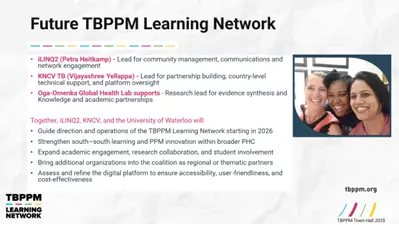
The meeting discussed the future of the TBBPPM Learning Network, highlighting the importance of private sector engagement in healthcare, particularly in TB service delivery. Petra presented the next phase of the network, emphasizing the need for continued learning, action, and evidence synthesis. She announced a new partnership involving KNCV, the University of Waterloo, and iLINQ2 to guide the network's evolution starting in 2026, with a focus on south-to-south learning, PPM innovation, and broader primary healthcare engagement. The group invited further participation and collaboration from the community to advance the PPM movement.
TBPPM Country Chapters: India & New initiatives
-
Meena presented the activities and future plans of the India chapter, including a new implementation research project funded by ICMR.
-
Kinz highlighted the potential for the Learning Network to play a key role in private sector engagement and sustainability beyond Tuberculosis, ensuring engagement in pandemic preparedness, climate change and other relevant areas.
-
Rabia discussed the relevance of PPM for Tanzania, emphasizing the need for stronger referral pathways and digital interventions to improve TB detection in mining communities.
The conversation ended with Petra thanking everyone for their contributions to the Learning Network – all TBPPM members, Team colleagues, Partners, collaborators and funders – and expressing optimism for its continued success in 2026.