
TBPPM Friday Forum: Why should we invest in TB now?
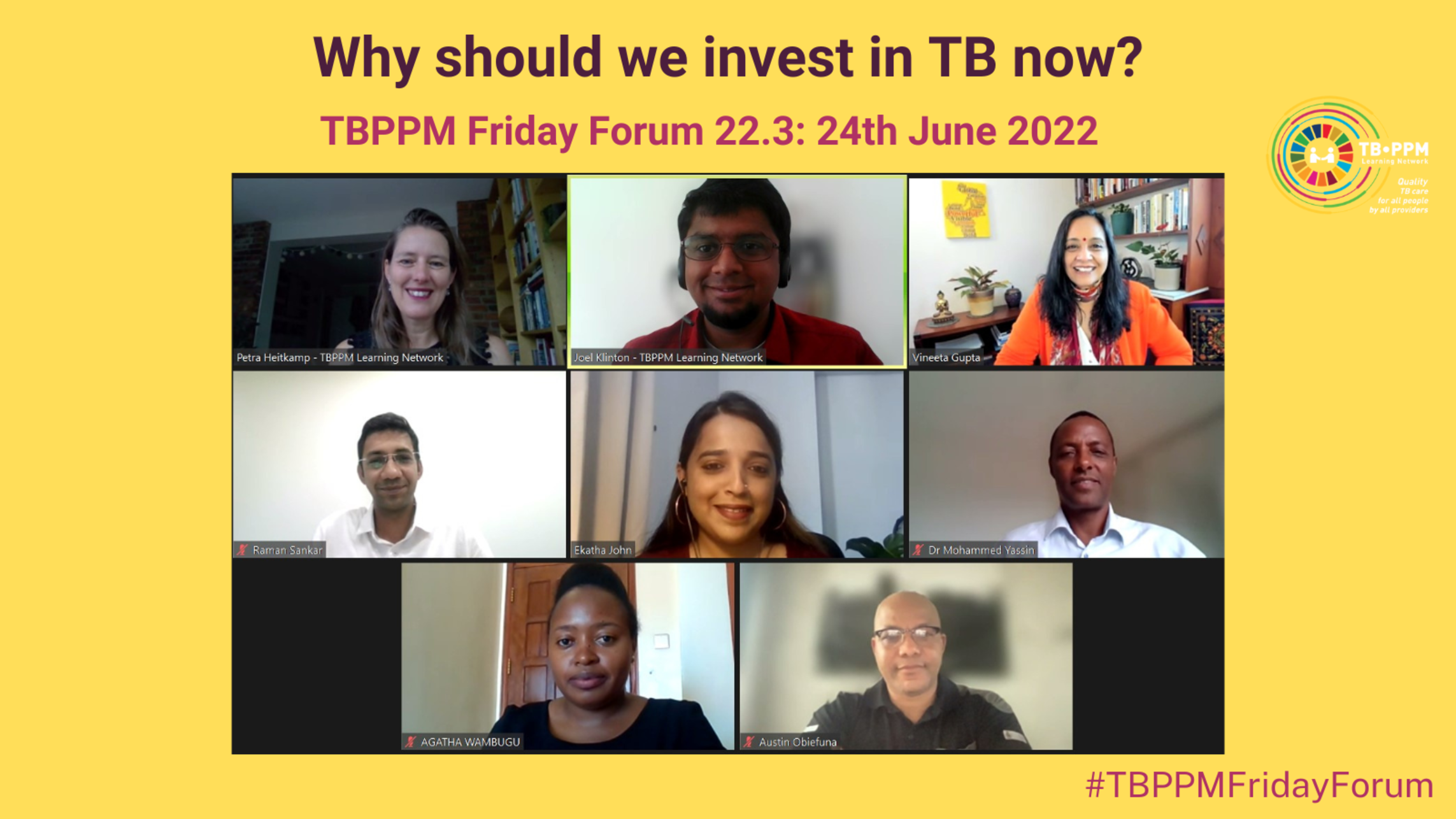
On the TBPPM Friday Forum held on June 24th, 2022, a panel of implementers, public health specialists, physicians and researchers discussed the various reasons for investing in tuberculosis and why everyone needs to be an active advocate for TB research and development. They shared key information from their experiences which are summarized below.
For the seventh replenishment, the Global Fund needs at least US$18 billion. This is the minimum required to pull the world back on track towards ending HIV, TB and malaria and build resilient and sustainable health systems strengthening public preparedness. This investment ensures making this world more equitable and safer from future threats.
The forum started with the moderator, Ekatha Ann John, emphasizing why it is imperative that $18 billion dollars get invested into the new Global Fund replenishment for TB eradication and for future preparedness.
“When COVID 19 happened, the pandemic took a toll on already overstretched health systems, reversed hard gains in the fight against TB and increased inequities. A minimum of 18 billion dollars is required to get the world back on track towards ending tuberculosis, HIV and malaria, to build resilient and sustainable health systems and to strengthen pandemic preparedness.” ~ Ekatha Ann John

- What are the most compelling arguments to policymakers on why we should invest in TB?
To reduce mortality and save lives:
“18 billion dollars would contribute to saving 20 million lives and reducing overall mortality from the three diseases by 64%. Drug resistant TB is a security threat, health threat and would affect many more people. We know that TB kills more than 1.5 million people every year. The replenishment of the Global Fund needs to be fully funded! We urgently need to get programs to tackle these three diseases (HIV, malaria and TB).” ~ Mohammed Yasin
“The most frustrating part about this is people are dying of preventable and curable diseases.” ~ Ekatha Ann John

To find the missing million:
“The WHO report last year showed around 4 million people to be missing, we don’t have any idea where they went, did they get care, what kind of care they got or whether they were treated? Bringing to the fore that there is this large number of people for whom we have no idea what care they got is very important to show the severity of the issue. The point of private-public partnership emerges from this missing million.” ~ Raman Sankar
To strengthen partnerships:
“Global fund has built strong partnerships at the country level, building synergies for sectors to be connected. COVID-19 has taught us many lessons. We need to reach people closer to where they seek care. The Global Fund has the country-led mechanisms to put programs in place.” ~ Austin Obiefuna

To get back on track
“We need new tools. We need to be ambitious. We are coming from using different strategies, from different countries, sharing ideas and bringing them at one hub. We can see the efforts global fund made in HIV awareness and treatment. There’s no stigma around HIV, people talk about it like a normal disease but there is a stigma around TB which means we still need funding.” ~ Austin Obiefuna
“Why not invest in TB now? Now is the moment. We believed that (TB) will be a disease of the past. But, here we are today, quarter century later and we are not only still dealing with it, but we actually slid back on the gains during COVID.

It is mind-boggling that when my dad was a kid, he had the same vaccine, I have the same vaccine, generations since are having the same vaccine. We’ve seen that when the world cares, it can mobilize around a disease to invest massively in developing half a dozen vax that stop a disease in its tracks. It’s unjust + immoral to allow TB to go unchecked because it particularly affects people who are most vulnerable. We won’t meet the goal if we don’t step up, we are already late.” ~ Vineeta Gupta
- What are some challenges with funding for PPM and what are some of the opportunities to advocate for TB and PPM to be a bigger part of the discussions within the Global Fund replenishment agenda?
Investing in private sector:
“Private sector does not compromise when it comes to policy so if we really want to engage private sector, they need to be in the center of that discussion.” ~ Austin Obiefuna
“I think it is important to first acknowledge that traditionally we have not engaged with the private sector in a very systematic manner. There is a need for change in mindset that needs to happen across the board. From program managers to the bureaucracy to political leaders to the government leadership. The change in mindset is majorly required and we must acknowledge it.” ~ Raman Sankar
“Investment in private sector is critical. We believe that addressing all three diseases and building health systems is not only the role of the government or public side and that’s why investing through the private sector is critical. In most countries, especially in Asia, most of the missing people are going to the private sector, that’s the first point of care for people in this part of the world and that’s where we need to go and follow the people, otherwise, we will never be able to end TB.” ~ Mohammed Yasin
Private Public Partnership:
“We should be using and positioning private sector resources as national resources that need to be used. The deep mistrust between private and public sectors needs to be bridged and we need to work in a more concerted manner.” ~ Raman Sankar

“Be it private or public sector, the main objective is to save life and end TB. For this the global fund investment is not only important as part of the overall allocation but as part of catalytic funding where countries receive additional money for finding the missing people, the private or PPM component has been scaled up.” ~ Mohammed Yasin
Sustainability:
“Between 2014 and 2017 in India, a study looked into the private sector engagement... performed a costing analysis to understand how much money was being spent on a patient in this model and compared it to the expenditure on one patient in the public sector. The study showed how the expenditure was similar in both models creating the basic argument that ..there is no need for the creation of more infrastructure, more human resources as these are all available in the private sector. All we need to do is scale up these different models in different places.” ~ Raman Sankar
A member of the audience Chelsea asked, “What are some of the best practices the panelists have seen in managing and coordinating private sector engagement in TB? Private sector is so disparate in most countries, how can we efficiently and sustainably coordinate?”
To this, our panelist Mohammed Yasin replied, “There are several approaches or models which are emerging in countries but what is most important is we all remain open to bringing private providers as partners while also engaging them during the planning and implantation process. This really ensures the sustainability aspect as well. It’s not only about looking at the evidence from lessons learned within the country, but we need to open ourselves to what is happening in other countries.”
- How can we make TB part of funding discussions, including Pandemic Preparedness, UHC, Antimicrobial Resistance and increase the overall funding for health globally?
Strengthening Health System:
“It is really about people and saving lives and not just about specific diseases. Unless we expand our access to basic services overall and strengthen the health system, both at public and private level, we will not be able to address the issue with TB. We need that 18 billion for global fund replenishment to help countries prepare themselves for the next pandemic but also build a sustainable health system and community system.” ~ Mohammed Yasin

Robyn Waite from our participants asked “How can we shift the model towards a multi disease approach? In reality, the approach is currently siloed”.
Agatha Wambugu responded, “We keep talking about patient-centered care, family-centered care, and holistic centered care but what I would like to repeat is a system that is missing a specific disease will miss other diseases.” Austin Obiefuna added, “It’s not only about the three diseases, its about building health systems. If you have a very strong robust health system, you can address a lot of issues. Not building these health systems at the central level but building them at the periphery so that people don’t have to travel all the way from the rural areas to the central areas to get quality health care.”

Decolonize Global Health and Advocate fiercely for TB:
Robyn Waite also raised a very important question, “As an advocate who engages in the fight to end TB for morally motivated reasons, I often find myself cringing at the real preference of the public and parliamentarians to hear the more self-interested arguments for investment in TB. Can any of our panelists speak to similar experiences and how they navigate that?”
In response to Robyn, Vineeta Gupta stated, “Sometimes we must make a self-interest…we take our goal and spin it into the communication strategy that would work with the policy makers who hold the purse. We need to shift from philanthropic charity to rights approach. We need to move from the self-investment case and state that this is the right thing to do and its not your choice. We need to decolonise the global health investment and promote equitable relationship between HIC and LMIC. No matter how many arguments we make which are cringeworthy to us as advocates, we need to keep hitting to ensure there is a paradigm shift…It is important to have a collective responsibility, multi-sector accountability, where each person needs to be at the forefront. There is TB everywhere and affects the people. We need to take the mutli-sectoral approach towards eradicating TB and working together to pull in more forces.”
In conclusion, TB Champion, Oluwafunke Dosumu says, “for ending TB we need to be more aggressive in our advocacy and we need to get to the grassroots and get what we want…., it has to be aggressive this time” with Vineeta Gupta stating how it is up to us and the future generations to make the difference, “hope is not in the people wearing suits and sitting in the boardrooms, the hope is in people who are advocating. Hand over this baton in the multigenerational relay race and make some progress in health equity”.

At the end of the Friday Forum, the participants and the panelists were invited to tweet out a message in support of the Global Fund's #FightforWhatCounts campaign. You can join the campaign by clicking the below link.

Moderator
Ekatha Ann John, Policy and Advocacy Manager, RESULTS ,Canada

Ekatha is a communications specialist with 10+ years of combined experience as a multimedia journalist and advocate for health equity in South Asia, the UK and Canada. I work in the space between communications and advocacy, research and capacity building, policy analysis, strategic partnerships building, stakeholder engagement, and multilateral relations.
Panelists
Mohammed Yassin, Senior Disease Advisor, TB, The Global Fund

Mohammed Yassin (MD, MSc, PhD) is a Senior Disease Advisor for TB at the Global Fund based, Geneva where he provides technical leadership on TB/MDR-TB and advises countries and Global Fund teams to ensure resources are invested to priority interventions and population to maximize impact. He started his career piloting the DOTS programme in Ethiopia over 20 years ago and later becoming a regional TB manager. Before joining Global Fund in 2010, he has worked in Liverpool School of Tropical Medicine, UK and designed, coordinated and implemented several multi-country implementation and research projects including a community-based TB care which was awarded Kochon prize in 2015. He is a member of several global task forces including PPM and GDI and contributes to policy development and implementation.
Agatha Wambuga, Regional Project Officer, Komesha TB, Kenya

Agatha is a project management professional with substantial experience in managing Health and Community Development programs that seek to promote nutrition, reproductive health and disease prevention.
Raman Sankar, Director, Global Health Strategies, India

Raman Sankar is a Director at Global Health Strategies, an international organization that uses advocacy, communications and policy analysis to advance issues and power campaigns that improve health and wellbeing around the world. Raman has been with GHS for the last seven years, and has led the team’s policy and advocacy efforts, to Ekheighten the discourse on TB among key stakeholder groups, including political leaders, the media, civil society and technical experts, to advocate for the introduction of comprehensive TB elimination policies and innovative programmatic interventions. Raman was trained as a journalist – he holds a PG Diploma in journalism from the Asian College of Journalism and a Masters degree from Cardiff University.
Austin Obiefuna, Vice Chair, Community Delegation Stop TB Partnership

Austin Arinze Obiefuna is the founder and the Executive Director of Afro Global Alliance Ghana, Vice Chair of the Stop TB Partnership Geneva, the former National Coordinator of Stop TB Partnership Ghana, National Coordinator for International AIDS Candlelight Memorial and the former Vice Chair of the Ghana Country Coordinating Mechanism for Global Fund. He serves on several boards nationally, regionally and globally including the Union Board and the Stop TB Partnership. Austin is also a WHO consultant and a member of the WHO AFRO Advisory Committee of Experts on Tuberculosis (AACTB), WHO TBTEAM consultant listing, and he specialized in public health communication consultancy, journalism and NGO management.
Vineeta Gupta, ACTION Secreatariat

Vineeta Gupta, MD, J.D., LL.M, is a global health expert, trained physician and human rights lawyer, and a passionate advocate for health equity and south-north partnerships. She is director secretariat at ACTION Global Health Advocacy Partnership. As a leading global health expert and human rights advocate, Gupta has conducted workshops on diversity, inclusion and health disparities and has been invited to speak in over 60 universities in the U.S. and Europe. She is widely covered in print and online media globally, including in the Washington Post, The Economic Times, The Hindu, Times of India, China Daily, NPR, U.S. News and World Report, Fox News and CNN.
Oluwafunke Dosumu, TB Champion, Nigeria

Oluwafunke Dosumu is a Life Coach, Motivational speaker, Author, Inspirational Writer, Professional Teacher, Community Activist, Entrepreneur and a great Artist. She is a TB survivor and Global Advocate. She is a professional, friendly, hardworking, reserved and serious minded person who has a track record of creative ways of maintaining excellence, productive and selfless service in whatever she does to the highest standards. I am a strong vibrant experienced intellectual individual who as a track record in areas of Advocacy, writing, presentation, content creation, analytical information. Finding ways of creative innovation in sustainability. She is a motivator, focused person. She has written book with great inspiration to stand the test of time with her experience. Funke Dosumu has worked tirelessly in her community, even though she lost her job in the process of her ordeal. She never gave up but created the avenue of empowering herself and others in her environment. She stand as a voice advocating on behalf of Survivors. She believed in herself and overcame the stigma. She is an author of many books including "Not Just Diagnostics And Medicines: How Young People Can Support Those With TB Through Treatment And Recovery."