
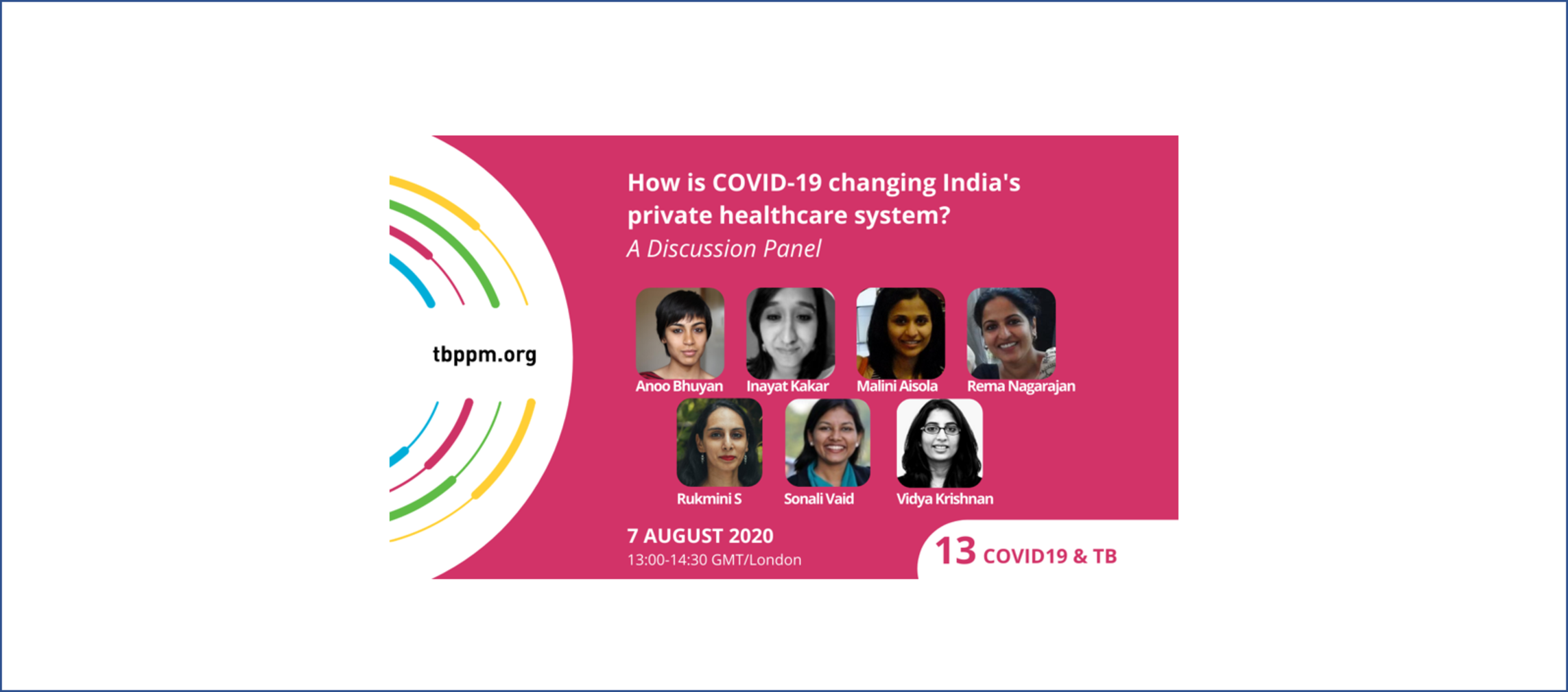
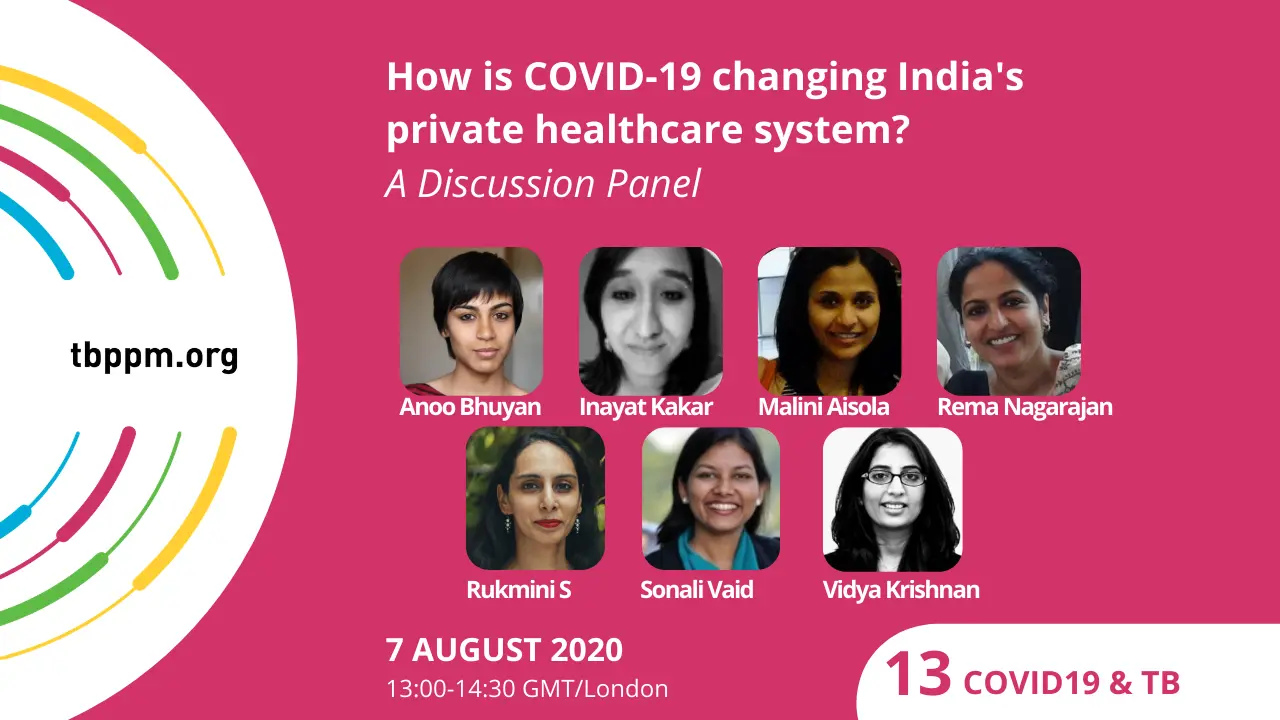
RECORDING NOW ONLINE: Webinar13 'How is COVID-19 changing India's private healthcare system?'
RECORDING NOW ON OUR YOUTUBE AND OUR SITE
How is COVID-19 changing India's private healthcare sector - TBPPM Webinar 7 August 2020
Click HERE to view the full webinar and on our YouTube Channel, to listen to the audio. Many background documents were mentioned and collated (see below). Please also find more details in this News article 'Hospital Audits, Clinical Outcome Data': How to Regulate Private Sector Hospitals during Covid-19 Crisis'.
Thanks to everyone for your participation and many questions (a Q & A is in development).
Background
With the COVID-19 pandemic now escalating in low- and middle income countries in Asia and Africa, all eyes are on the resilience of their healthcare systems. WHO has called for a ‘All hands on deck’ approach in response to the pandemic, and called for both private and public sectors to work together to meet the rising needs for healthcare.
India, with a large, dominant private sector is challenged to engage the private health sector in COVID-19 response. Patients are struggling to access private healthcare and prices are going up for all services. There are challenges in test prices in the private sector and overall the government grapples with pricing and regulating large corporate hospitals. And beyond COVID-19, people are facing big challenges to get treatment for other health conditions. How is the private health sector adapting to the pandemic, and what can Indaia do to move towards an equitable, robust healthcare system?
Summary of the Discussion Panel
"It is not that the pandemic has broken India's health system. It was already broken. Pandemic is not the right time to fix it. But when this is over, can we please use this chance to fix things?" @AnooBhu
Many good suggestions on how to fix India's healthcare system:
- Right to health must be a political/election issue
- Need to advocate for "one nation, one healthcare" approach
- India has to dramatically increase spend on health (2.5% of GDP nowhere close to sufficient)
- Public sector must improve quality of care/service
- Private sector must be better regulated
- Private hospital billing must be audited
- Private hospitals must be more transparent & provide itemized bills
- Medicines & products must be validated before marketing Indian public has low confidence in the public health sector and does not trust the private health sector either.
Neither sector can adequately deal with India's health needs, especially during a crisis. Both sectors have to contribute & the government must set norms & policies.

Reading and reference
- The Callousness of India’s COVID-19 Response: The government is showing how not to handle a pandemic – Vidya Krishnan
- Apollo hospital in Bengaluru gets notice for overcharging COVID-19 test – Malini Aisola
- From Treatment To Medical Gear, Patients Paying More In COVID Times – Anoo Bhuyan
- How covid-19 response disrupted health services in rural India – Rukmini S
- Podcast episode on private healthcare in India ' Breaking through Binaries' - Rukmini S
- Covid-19 and unregulated private hospitals: Lessons for Private Sector Engagement – Inayat Kakar
- Delhi: Order on capping rates leaves private hospitals in a fix – Rema Nagarajan
- Can the coronavirus crisis guide India towards an equitable, robust health system? – Sonali Vaid, Madhu Pai
Panel Discussion moderated by Dr Madhukar Pai
Anoo Bhuyan, Data Journalist
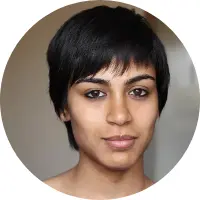
Anoo Bhuyan reports on healthcare at IndiaSpend. She has also reported on issues of law and justice, technology and society and gender. Before IndiaSpend, she worked at The Wire, Outlook Magazine, BBC News and National Public Radio. In 2018, she won Bournemouth University’s ‘Journalist of Change’ award for her reporting on extra judicial killings in Manipur. She also received a scholarship for her postgraduate degree at the School of Oriental and African Studies, University of London. She can be reached on Twitter
Sonali Vaid, Healthcare Improvement Advisor
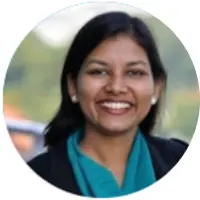 Sonali Vaid is a physician by background and a public health specialist. Her work focuses on the application of quality improvement science to deliver better results and to make health care more humane. She is a graduate of the Harvard T. H. Chan School of Public Health and has consulted for and collaborated with governments, academic institutions and international organizations such as WHO, UNICEF, URC and MSF. She is a frequent trainer, facilitator, speaker at several national and international workshops and conferences on quality of care. She is a proponent of human rights in healthcare and believes in human dignity, equality, justice and the right to healthcare She can be reached on Twitter
Rukmini Shrivanas, Data Journalist
 Rukmini is a Chennai-based independent data journalist. She is the former Data Editor of The Hindu and Huffington Post India. Been doing nightly 5-minute podcasts during the COVID-19 crisis.
Inayat Kakar, Peoples Health Movement
 Inayat is a qualitative researcher and activist affiliated with rights based people’s groups such as the People’s Health Movement, National Alliance for People’s Movements, All India Drug Action Network, CommonHealth etc. She holds a bachelor’s degree in law and a masters degree in social work in public health. Her work has broadly focussed on rights of people accessing health services in India. During the pandemic she has been actively helping covid and non-covid patients facing denial or difficulties in accessing healthcare. She can be reached on twitter at https://twitter.com/inayat_s_kakar
Rema Nagarajan, Journalist The Times of India
 Rema Nagarajan is with the Times of India where she works with a group that does data-driven stories. She writes mostly on health policies and healthcare delivery related issues.
Vidya Krishnan, Journalist
 Vidya Krishnan, a freelance reporter who has covered healthcare in India for 17 years, says she has never seen the kind of harassment and threats that health reporters have received while covering COVID-19. Vidya has been reporting on the disease since February, and has highlighted the government’s failure to stockpile protective equipment for health workers. She has written a book on TB "Phantom Plague" that will come out next year, and will be joining Harvard University as a fellow in September 2020.
Malini Aisola, Drug Action Network
 Malini Aisola is a Co-Convenor of the All India Drug Action Network (AIDAN), a public health group which has been working on regulatory reforms to improve affordability and access to medicines, devices, and also for regulations to reign in corrupt, unethical practices in private healthcare. During the pandemic, she has actively been monitoring and engaging on policies related to the approval, pricing and procurement of COVID-related health products such as test kits, PPE, etc.; and the involvement of the private sector in testing and treatment. Her work with AIDAN has consistently advocated for greater transparency & release of information to the public. She is a vocal patient advocate and has been assisting patients and their families, many of whom have faced great hardship due to the high cost of COVID-19 treatment.