Global TB Report 2023: PPM section
Global TB Report highlighting areas relevant to engagement of private providers
In 2022, TB was the second leading infectious disease killer worldwide, after COVID-19. It was also the leading killer of people with HIV and a major cause of deaths related to antimicrobial resistance (READ MORE in the Global TB Report 2023).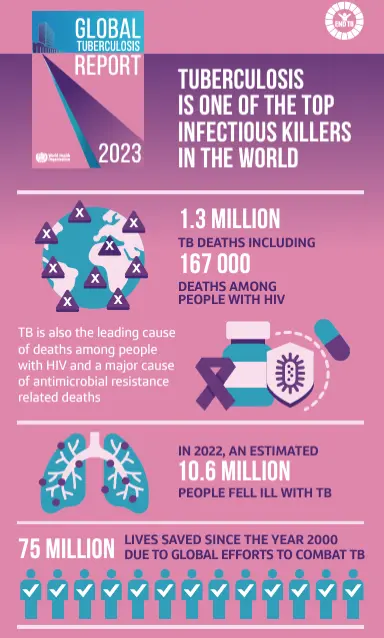
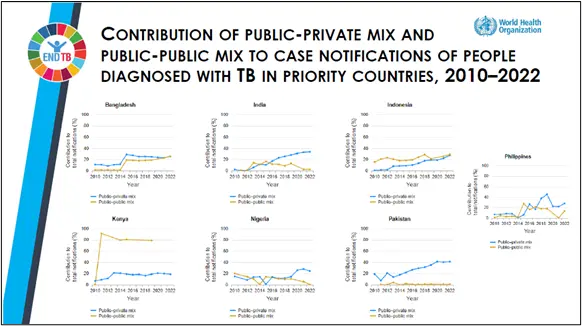
Globally in 2022, the reported number of people newly diagnosed with TB was 7.5 million. This is the highest number since WHO began global TB monitoring in 1995, above the pre-COVID baseline (and previous historical peak) of 7.1 million in 2019, and up from 5.8 million in 2020 and 6.4 million in 2021. Eight countries accounted for more than two-thirds of the global total: India, Indonesia, China, the Philippines, Pakistan, Nigeria, Bangladesh and the Democratic Republic of the Congo. Most of these countries have a large private healthcare sector, and national programs have taken considerable efforts to engage private providers, which is illustrated in the increased TB notifications from PPM in the graphs below (as presented by WHO in the PPM WG meeting, Nov'23).
Some sections that are immediately relevant to TBPPM:
WHO’s multisectoral accountability framework to accelerate progress to end TB (MAF-TB)
Progress in combating tuberculosis (TB) cannot be achieved by the health system alone; it requires firm political commitment at the highest level, strong multisectoral collaboration (beyond health) and an effective accountability system. Since 2019, countries have been supported in systematically adapting and implementing the multisectoral accountability framework to accelerate progress to end TB (MAF-TB) by the World Health Organization (WHO) and partners. To support countries in MAF-TB operationalization, WHO has developed the following documents: an operational guide, a compilation of best practices on MAF-TB adaptation and implementation, and a baseline assessment checklist for country use in pursuing a national MAF-TB.
Public–private mix monitoring and data dashboards in priority countries for stronger accountability
In addition to engagement across multiple sectors, it is also necessary to engage all care providers in the TB response, including those in the private and informal sectors. These providers are often the first point of care for TB patients. Failure to engage with these providers can have negative consequences, including increased transmission, increased drug resistance, catastrophic costs for TB patients and their households, and incomplete monitoring and evaluation. Such consequences can arise form factors such as delayed diagnosis, inappropriate or incomplete treatment and out-of-pocket expenditures.
Countries have mainly focused on tracking notifications from private and unengaged public sector care providers rather than a broader scope of indicators across the patient pathway. Recently, WHO has led efforts to strengthen PPM monitoring and accountability through an initiative with the Bill & Melinda Gates Foundation. This aims to develop enhanced PPM data dashboards in seven priority countries: Bangladesh, India, Indonesia, Kenya, Nigeria, Pakistan and the Philippines.
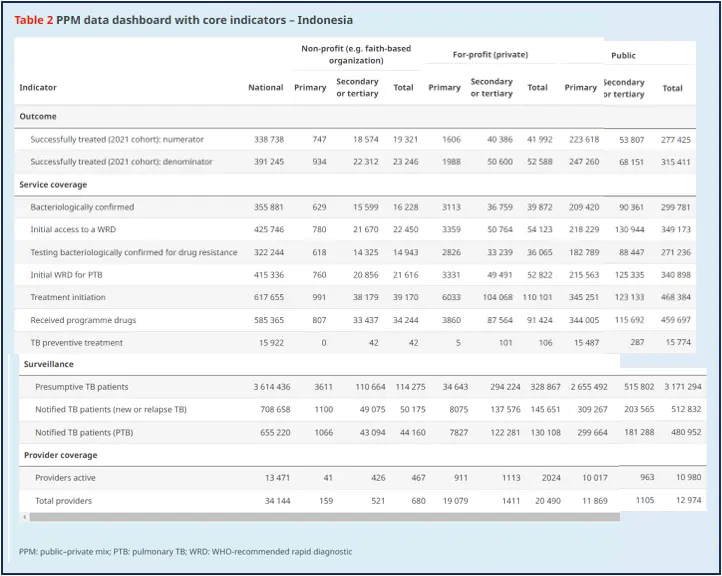
The indicators in the PPM dashboard are aligned with WHO guidance on TB surveillance and with WHO benchmarks and indicators related to universal access to rapid TB diagnostic tests, grouped into four categories: provider coverage, surveillance, service coverage and treatment outcomes. Disaggregation of data by ownership and health facility level are both core components of the PPM dashboard, to better understand patient pathways. Such disaggregation will also provide information about differences among providers in access to services such as WHO-recommended rapid diagnostics (WRD).
An example of the results produced from use of the PPM dashboards in Indonesia is provided in the Table.